
How to describe your service area as an energy installer
16 November 2026
Write a clear installer service area with towns, per-service limits and work by arrangement. Includes a coverage worksheet and ready-to-adapt wording.
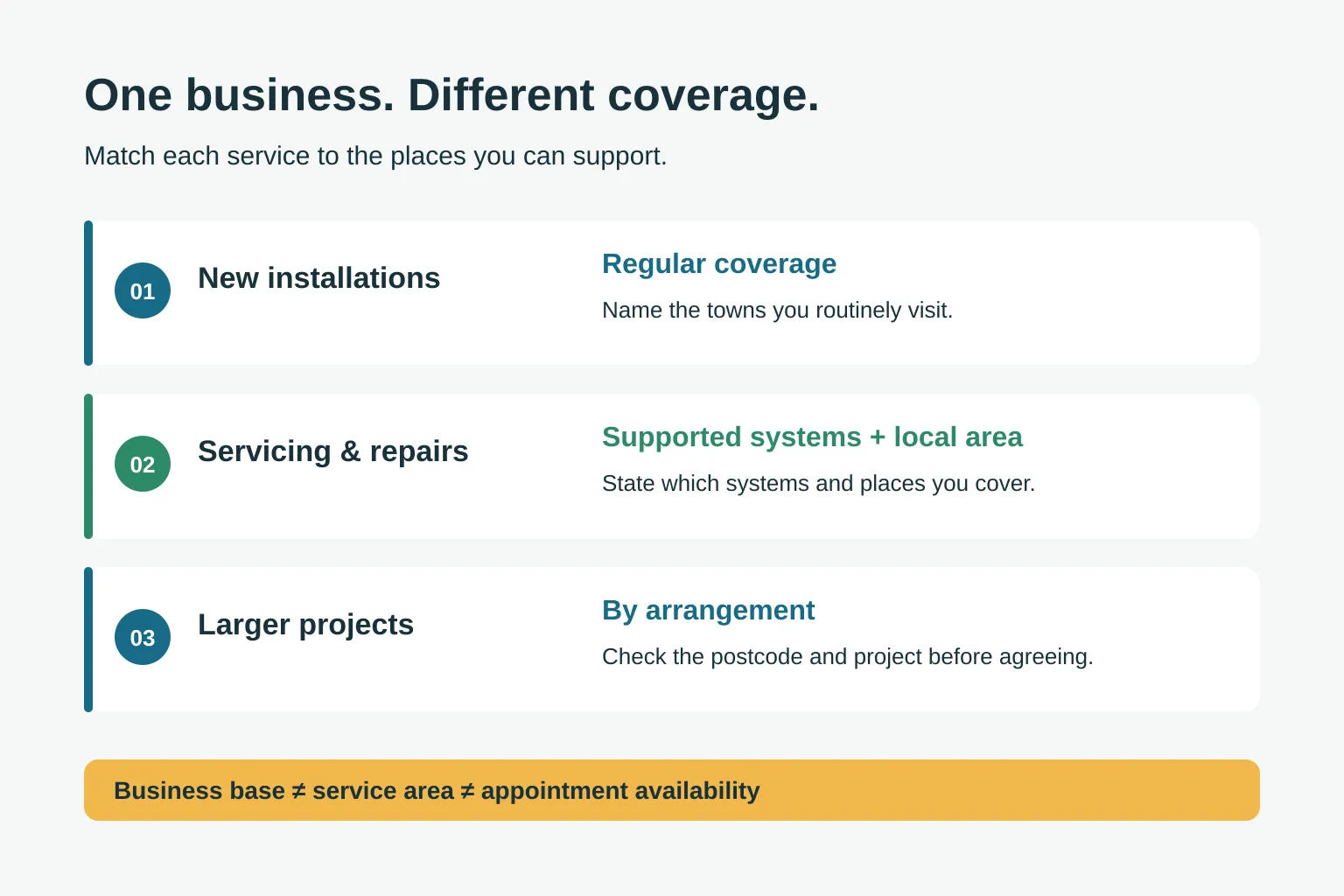
To describe your service area, name the places you regularly cover and say which energy services are available there. Separate normal coverage from work considered by arrangement, and explain any limits on servicing or repairs. Your business address tells customers where you are based; your service area tells them where you will take work.
How to describe your service area before writing a listing
Start with a coverage note agreed by the person who schedules jobs. Use recent work, current staff capacity and the journeys your team can actually make, rather than a list of towns you would like to appear in.
For each service, write down:
- Regular coverage: towns, postcode districts or whole counties where you routinely accept that work.
- Coverage by arrangement: places where you consider particular projects, with the condition that matters.
- Support limits: whether you service systems installed by other businesses, and any equipment or geographic restrictions.
- Enquiry check: the information staff need before accepting work near the boundary.
Keep appointment availability separate. Covering a town does not mean you can attend tomorrow. If customers need an urgent repair, tell them how to check availability rather than implying that your installation territory is also an emergency-response area.
A county name is useful only if the coverage statement really applies across that county. If you serve part of it, name the towns or districts instead. Replace “and surrounding areas” with a boundary a customer can use, or a clear request to send their postcode for a coverage check.
Use separate areas for installation and aftercare
A single area can be misleading when your services have different limits. A team might travel farther for a planned installation than for a short servicing visit. Remote advice also does not mean that on-site repairs are available everywhere.
Consider this fictional heat-pump business based in Lincoln. Its team agrees the following coverage before writing any public wording:
| Work | Agreed coverage | Condition to explain |
|---|---|---|
| Domestic air-to-water heat-pump installation | Lincoln and Newark | Planned installation work, subject to a property assessment |
| Routine servicing | Lincoln | Systems the business installed; appointments booked in advance |
| Larger commercial installations | Grantham considered by arrangement | Review the postcode and project brief before agreeing to visit |
The business should not compress this into “Heat-pump installation and servicing across Lincolnshire and Nottinghamshire”. That would suggest wider coverage and make the servicing restriction disappear.
Its public service-area wording could be:
Domestic air-to-water heat-pump installations in Lincoln and Newark, subject to a property assessment. Routine servicing in Lincoln is available for systems we installed, by appointment. Larger commercial installations in Grantham are considered by arrangement. Please send your postcode and the work required so we can confirm coverage and availability.
The statement identifies where each service applies without listing every operational detail. If the team later accepts servicing of other systems, it can change that sentence after agreeing the equipment it supports; it does not need to broaden the installation area too.
Write your own coverage statement in three lines
Use this structure, replacing every bracket with a fact your business can support:
We provide [specific service] in [regular coverage areas].
[Different service or project type] is available in [its actual areas], with [relevant restriction or arrangement].
For coverage checks, send [postcode or town] and [the work required]; we will confirm whether we can take the job.
Remove the second line if all services genuinely share one area. If you do not take work outside your regular coverage, leave out any suggestion that exceptions are possible.
“Nationwide” should describe an existing delivery arrangement. Before using it, check who can survey, install and provide the aftercare you advertise in those locations. A subcontractor's possible availability is not a confirmed nationwide service.
Should you use towns, postcodes or a radius?
For website and directory wording, use the location names your customers recognise. Towns work well for a short local list; postcode districts can explain a boundary more precisely. A radius may help internal planning, but a straight-line distance does not show the road journey or tell customers which side of a boundary they fall on.
Google Business Profile has its own rules. Google's service-area guidance, checked in November 2026, says businesses must specify cities, postal codes or other areas rather than a radius. Google allows up to 20 service areas and says the overall boundary should not be more than about two hours' driving time from the business base.
Those are Google profile rules, not a universal limit for energy installers or other directories. Keep the underlying coverage facts consistent, then adapt them to each site's fields. Do not choose 20 areas simply because Google allows 20.
Keep your business base separate from customer visits
Being based in one town does not establish an office in every town you serve. Describe travel coverage as coverage, rather than using “our local office” for a place where you have no office.
Google also says that businesses which do not serve customers at their business address should remove that address from their public Business Profile and use a service area. A business that both serves customers at its address and travels to them can show an address and a service area under Google's hybrid-business rules. Follow the same Google guidance for that profile; check the address requirements of other listings separately.
If customers cannot visit your premises, say “Site visits by appointment; no customer reception at our business base” where that is accurate. It prevents someone treating your address as a showroom.
Give staff a clear reply for boundary enquiries
Ask for the postcode and service first. A full property address is not usually needed just to establish whether a town or postcode district falls within your coverage.
For a job you may consider, use:
Please send your postcode and whether you need installation, servicing or a repair. We will check coverage for that service and confirm availability before arranging a visit.
For an area you do not cover, use:
Thank you for asking. We do not currently provide [service] in [area], so we cannot arrange this job.
If travel charges, project minimums or equipment restrictions affect acceptance, explain the applicable condition before someone commits to a visit. Do not leave “by arrangement” for staff to interpret differently each time.
Reuse the agreed wording across your public profiles
Keep one approved coverage note and update it when staff, services or support arrangements change. Check your website, directory profiles and enquiry replies against it. A shorter version can omit detail, but should not turn conditional coverage into an unconditional promise.
Once the area statement is accurate, use the energy business listing guide to check the rest of your profile: services, credentials, project information and contact routes. The free preparation option below gives you somewhere to put the finished coverage wording alongside those details.