Renewable energy for business premises: what to assess first
15 November 2026
Assess business energy demand, lease rights, site constraints, technology options and whole-life costs before requesting renewable-energy proposals.
Assess renewable energy for business premises by starting with demand, site constraints and the right to make changes. Collect energy-use information, identify efficiency improvements and then compare suitable technologies. A system that fits another business may not fit your building, operating hours or lease.
UK guide. Sources and policy references checked on 15 November 2026.
Start with a clear business objective
Decide whether the priority is reducing bought electricity, replacing fossil-fuel heating, improving resilience or supporting an evidenced emissions-reduction plan. These objectives can overlap, but they do not lead automatically to the same equipment.
Set practical constraints: available capital, acceptable disruption, required approval stages and how long you expect to occupy the premises. Identify who will own the project internally and who can approve building alterations.
The Carbon Trust's feasibility and technical advice sets out how specialists assess possible projects. Use a feasibility study to test options against your site, rather than treating a technology list as a recommendation to install every option.
Understand when and where energy is used
Gather at least a recent full year of electricity and heating-fuel data where available. Record kWh, tariffs, standing charges and relevant contract dates separately. If your metering provides interval data, use it to see demand across working days, nights and weekends.
List major loads: space heating, hot water, refrigeration, compressed air, production equipment and vehicle charging. Explain seasonal changes and planned expansion. A full-year total alone may hide the mismatch between generation and demand. If vehicle charging is planned, use our home and small-business EV charging guide to define parking times, access and charging demand before the assessment.
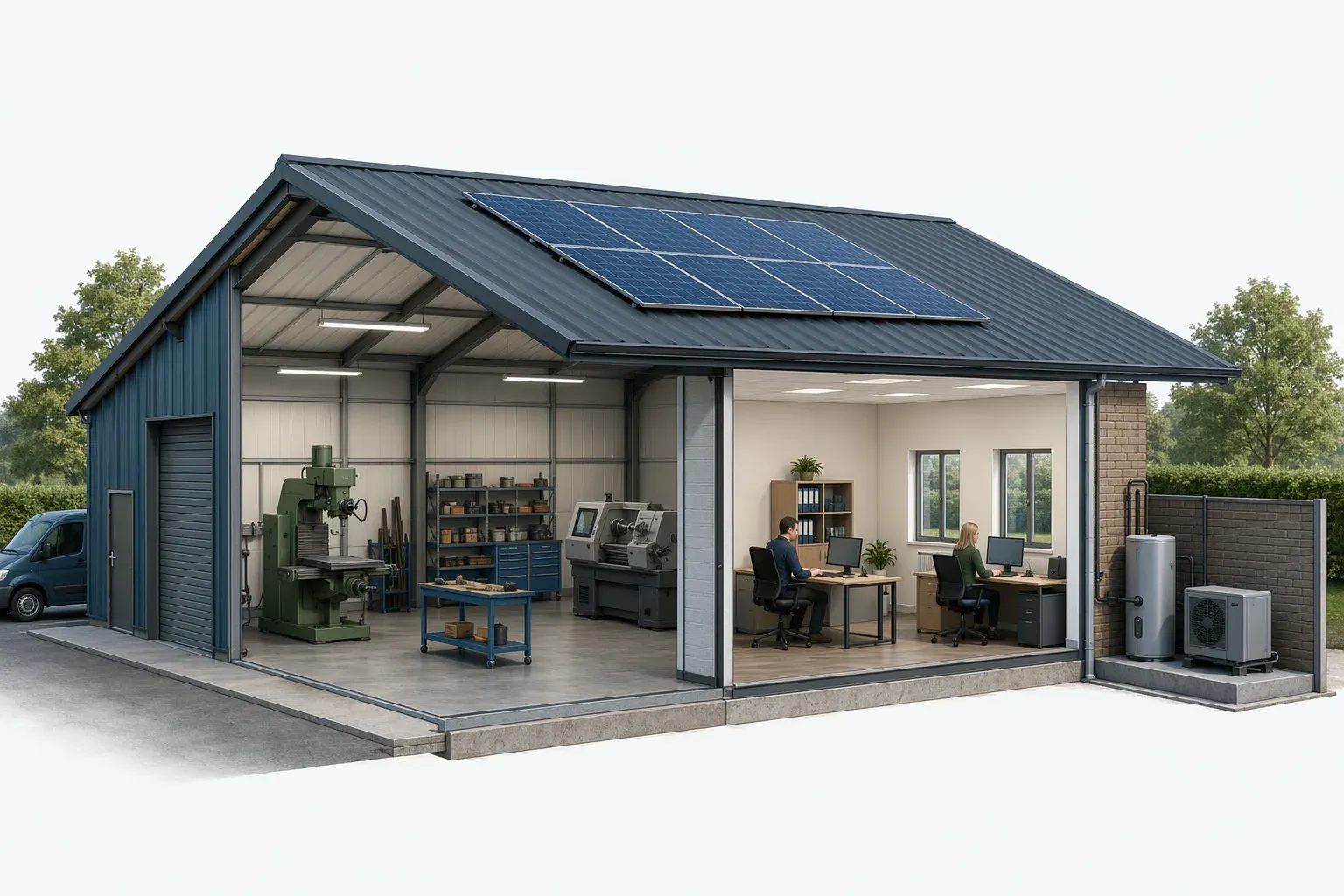
A daytime workshop with steady weekday electricity use raises different solar questions from a business operating mainly at night. Both need a calculation of likely direct use and export; neither should assume all generated electricity replaces bought electricity at the import price.
The Carbon Trust's feasibility guidance describes site surveys, meter-data analysis and whole-life costing as parts of project assessment.
Check efficiency measures before sizing new equipment
Ask whether controls, maintenance and avoidable losses can be improved first. Review heating schedules, lighting, equipment left running out of hours and other known sources of waste with the appropriate specialist.
This matters for sizing. If heating demand is reduced through planned building work, a heat-pump proposal should reflect the improved building. If production demand will increase, the appraisal should state that separately rather than quietly treating it as today's load.
Record agreed improvements and the order of work. Avoid comparing one quote based on current demand with another based on a renovated site without noticing the difference.
Confirm ownership, roof condition and site constraints
For leased premises, establish consent, lease length, responsibility for repairs and what happens to installed equipment at the end of the tenancy. A project can be technically plausible but unsuitable for the occupancy agreement.
For solar, assess roof condition, structural capacity, available area, shading and safe access. A roof approaching replacement may change the sensible installation sequence. For heating, assess heat demand, distribution systems, plant space and any changes to production hot water.
Ask about electrical capacity and the distribution network process early. Network restrictions, export limits or reinforcement costs can change the business case. Planning and building requirements vary by UK nation, site and technology; the installer should identify the checks, not assume a domestic rule covers a commercial project.
Build a shortlist, not a shopping list
Use the site's constraints to decide which options deserve a feasibility study.
| Option | First questions to investigate |
|---|---|
| Solar PV | Is suitable roof or land available, and how does daytime output align with demand? |
| Heat pump | What heat temperatures are required, and can the building and distribution system support the design? |
| Wind | Is the local wind resource suitable, with acceptable siting, access and planning prospects? |
| Biomass | Is there a workable fuel supply, storage, delivery route and maintenance arrangement? |
| Battery storage | What specific timing, tariff or resilience problem is it intended to solve? |
Solar PV produces electricity; solar thermal provides heat. A battery stores energy and is not itself a renewable source. Biomass and wind need site-specific assessments rather than being treated as interchangeable alternatives to roof solar.
If solar makes the shortlist, our questions to ask a solar installer cover equipment, generation assumptions and aftercare. Use those questions alongside a commercial site assessment, not as a substitute for one.
If resilience is a priority, ask explicitly what works during a power cut. Do not assume a standard grid-connected installation provides backup power.
Compare whole-life costs and test the assumptions
Request a written appraisal including design, equipment, installation, structural or electrical work, permissions, maintenance, replacements and any ongoing monitoring or finance charges. Compare purchase and third-party ownership proposals on the same basis.
Ask for the assumed generation, direct use, import and export prices, performance changes over time and operating costs. Test a less favourable case: lower direct use, a different tariff, higher maintenance cost or a shorter occupancy period.
For eligible electricity generation in Great Britain, the Smart Export Guarantee may be relevant. Supplier eligibility and tariff terms need checking; the scheme does not apply in Northern Ireland. Do not count an unconfirmed grant or export agreement as secured income.
Keep environmental claims as specific as the project
If you plan to publicise the installation, record the boundary of any environmental claim. Generating some electricity on site is not the same as making the whole business emissions-free.
The Advertising Standards Authority's renewable-energy guidance explains that objective claims need evidence and that broad claims can mislead by omitting important information. State what changed and how it was measured, rather than relying on an unqualified “green business” label.
Next step: search for business energy providers
Bring together the site address, occupancy terms, energy data, operating hours, known building issues and project objectives. Ask each provider to identify missing information before offering a final design.
UK Energy & Renewables helps businesses discover energy providers. A directory entry is not an endorsement or a feasibility assessment; evaluate the provider's relevant experience and written proposal yourself.
Search the directory using the service you need and your town or postcode. Check that each provider undertakes commercial work before sending your brief.